Week 7-8
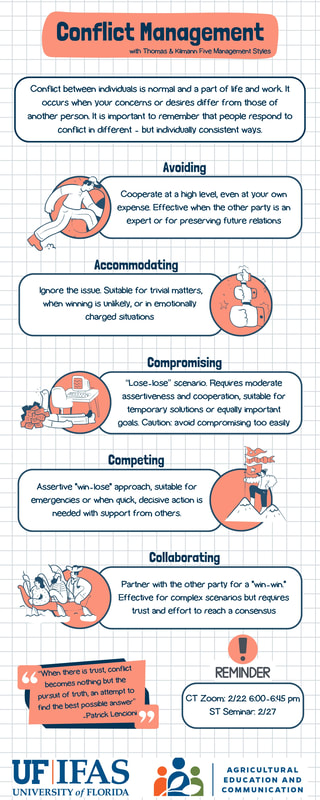
As you approach the mid-point of the internship experience, conflict between individuals is normal and a part of life and work. It occurs when your concerns or desires differ from those of another person. It is important to remember that people respond to conflict in different - but individually consistent ways. Remember to take some time with your interns to address any conflict that may be occurring.
Common Sources of Conflict Between Cooperating Teachers and Student Teachers:
By knowing your own default patterns of addressing conflict, you improve your self-awareness. Once you are aware of your own patterns, you can pay attention to whether they are working for you, and you can explore alternatives. By using a scenario-based approach, you can choose more effective conflict management styles and test their effectiveness of you and your situations (Thomas, K.W., and R.H. Kilmann).
Common Sources of Conflict Between Cooperating Teachers and Student Teachers:
- Personal: Conflict related to personality, behavioral decisions, life experiences, views and values, etc.
- Pedagogical: Conflict related to preferred teaching methods, preparations, philosophy, classroom management, etc.
- Professional: Conflict related to relationships with students and colleagues, professional dress, networking approaches, career aspirations, etc.
By knowing your own default patterns of addressing conflict, you improve your self-awareness. Once you are aware of your own patterns, you can pay attention to whether they are working for you, and you can explore alternatives. By using a scenario-based approach, you can choose more effective conflict management styles and test their effectiveness of you and your situations (Thomas, K.W., and R.H. Kilmann).
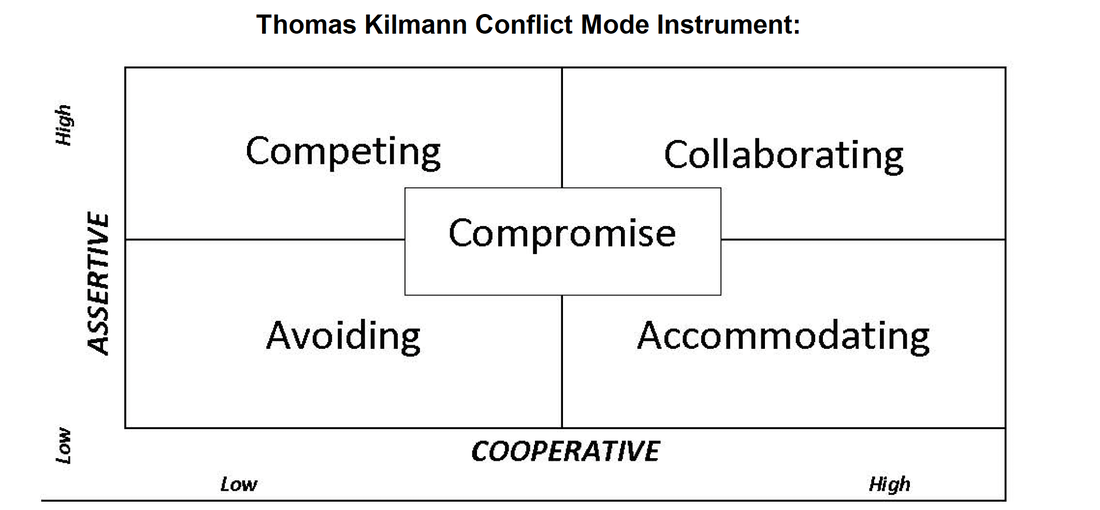
1. Accommodating This is when you cooperate to a high-degree. It may be at your own expense and actually work against your own goals, objectives, and desired outcomes. This approach is effective when the other party is the expert or has a better solution. It can also be effective for preserving future relations with the other party.
2. Avoiding This is when you simply avoid the issue. You aren’t helping the other party reach their goals, and you aren’t assertively pursuing your own. This works when the issue is trivial or when you have no chance of winning. It can also be effective when the issue would be very costly or when the atmosphere is emotionally charged and you need to create some space. Sometimes issues will resolve themselves, but “hope is not a strategy.” In general, avoiding is not a good long term strategy.
3. Collaborating This is when you partner/pair up with the other party to achieve both of your goals. It’s how you break free of the “win-lose” paradigm and seek the “win-win.” This can be effective for complex scenarios where you need to find a novel solution. This can also mean reframing the challenge to create a bigger space and room for everybody’s ideas. The downside is it requires a high-degree of trust, and reaching a consensus can require a lot of time and effort to get everybody on board and to synthesize all the ideas.
4. Competing This is the “win-lose” approach. You act in a very assertive way to achieve your goals, without seeking to cooperate with the other party, and it may be at the expense of the other party. This approach may be appropriate for emergencies when time is of the essence or when you need quick, decisive action, and people are aware of and support the approach.
5. Compromising This is the “lose-lose” scenario where neither party really achieves what they want. This requires a moderate level of assertiveness and cooperation. It may be appropriate for scenarios where you need a temporary solution or where both sides have equally important goals. The trap is to fall into compromising as an easy way out when collaborating would produce a better solution.
Check out this document for appropriate uses of these styles: Conflict Management Handout
Mentor Motivation |
|
“When there is trust, conflict becomes nothing but the pursuit of truth, an attempt to find the best possible answer”
-Patrick Lencioni
Reminders |
|
- Student teachers should be following the Spring Break of their school site.
-Don't forget to complete the weekly evaluations!
- The bi-weekly rating form must be completed on the required weeks (Now set for weeks 3, 5, 7, 9, 11, 13, and 15). You also fill this out after your intern has filled in their column.
-Be sure to give regular verbal and written feedback to your intern.
Example Documents & Teacher Support
|
Examples of the feedback and mentoring language can be found in the Cooperating Teacher Manual and on the Giving Feedback page.
Examples of the evaluation and rating forms can be found on the Forms page. |
Upcoming Intern Activities
- Cooperating Teacher Zoom Call: February 22nd at 6pm.
- Intern Seminar is scheduled for February 27th virtually at 4pm
- Intern Seminar is scheduled for February 27th virtually at 4pm
This Week's infographic: conflict_management.pdf